Ants in the Sugar

Reading the latest ins and outs of the debate over fracking and the Keystone XL pipeline got me thinking about larger issues related to energy. And this reminded me of a story…

Once upon a time, a small nest of ants lived outside a big, grand house that had been abandoned by its owners. Like all the other animals, the ants struggled to find food and raise their babies. Then one day, a worker ant was exploring and found a crack in the wall of the grand house and went inside. There, she found a few flecks of a marvelous, sweet, energy-bearing substance that she brought back to the nest. The sugar was a big hit. So rich and wonderful! The queen laid many eggs and sent workers to find more of the miracle stuff. Lo and behold, the workers came upon a large deposit of the high-energy food deep within the walls of the house, high up on a shelf. A huge bag of sugar! They laboriously chewed a small hole in the side of the bag and began carrying sugar granules one by one back to the nest.

Over succeeding weeks, the nest thrived. Using this concentrated food was so much easier than foraging far and wide through the yard. The nest soon expanded and sent out new colonies. And each colony chewed its own hole in the sugar bag. Every one of them depended on sugar from the bag because that was the best way to keep growing. And, it was so, so easy.

A few of the ants mentioned to the queen that surely the sugar would run out one day. The queen just laughed and scorned them because they were only drone ants, who simply thought about things and did not do real work. She pointed out that the drones could not even agree among themselves exactly when the sugar would run out. Still, it seemed to her that it might be wise to ensure a steady supply of sugar, and so she sent soldier ants to capture the openings that other colonies had made in the sugar bag. But her daughters, the queens of the other colonies, had the same idea. There were many skirmishes and not a few large battles. The demand for sugar actually grew as each queen realized she needed to lay even more eggs to raise even more soldier ants to fight for more sugar.

As the cost of battles increased, the drones still droned on about running out of sugar. A few even went so far as to suggest that the ants look for a different source of food entirely, one that would never run out. After all, they pointed out, at one time not that long ago, all ants had lived without any sugar at all. The queen sneered and replied that there were far fewer ants then. And what, exactly, would they do, anyway? Live on sunlight like plants? Hah! The drones went back to their holes and fretted. The queen made plans to intensify the search for sugar. Surely there must be more in there somewhere…

I don’t know how the story of the ants ends. Do they:
a. Amazingly find ever more and more sugar in the abandoned house?
b. Share the ever-dwindling sugar supply evenly and fairly and let their population decrease to a sustainable level?
c. Use the remaining sugar not to raise more soldier ants but to raise worker ants who figure out an alternative to sugar?
d. Fight more and more battles to control the sugar bag until they exhaust both themselves and the sugar supply at about the same time—leading to a catastrophic collapse of all the ant colonies?

You tell me what the ants do. What should they do? What should we do?
Back Online

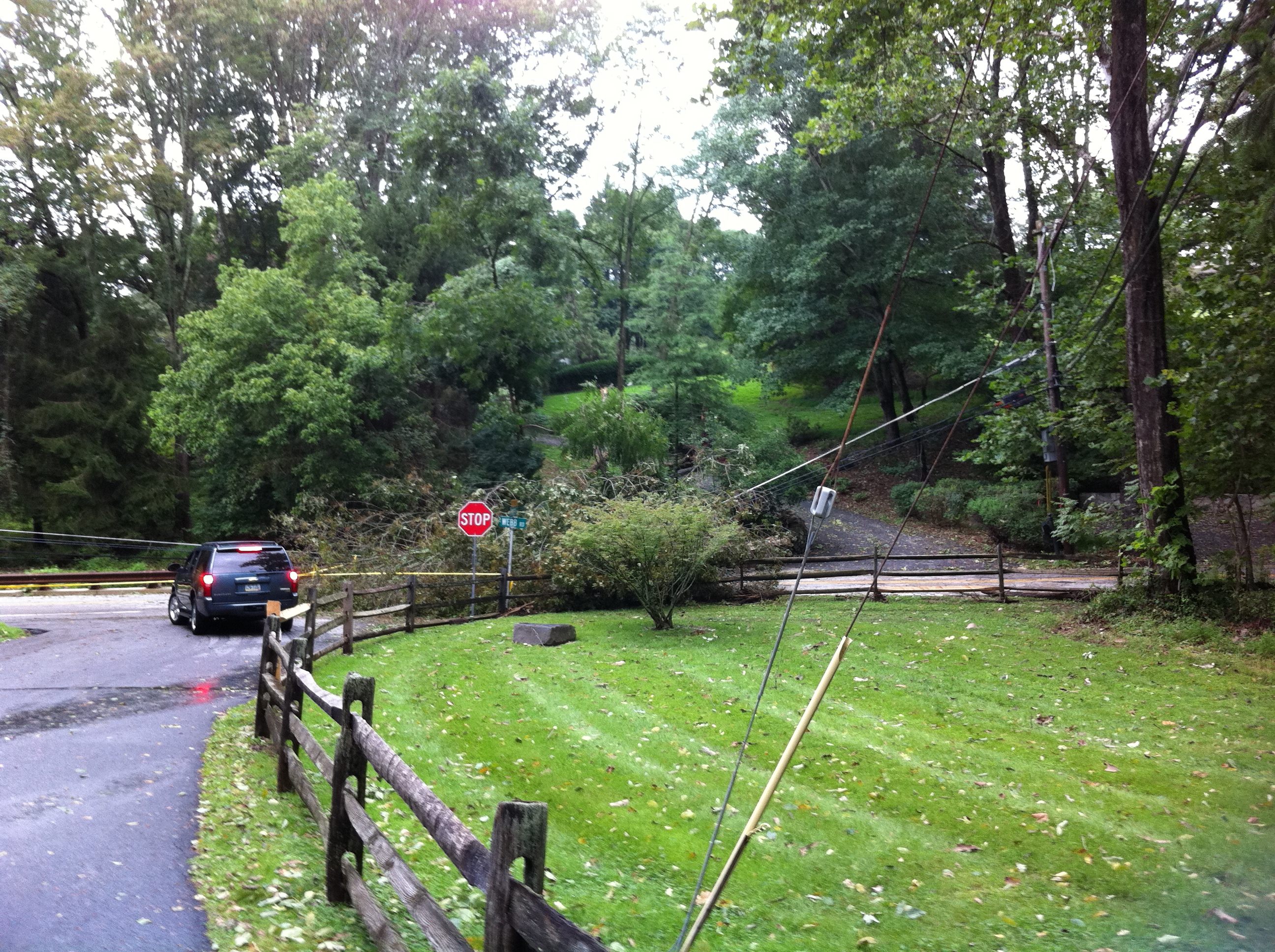
Well, the hurricane certainly was interesting. Sunday afternoon following the storm, just as my wife and I were basking in the delight of a storm with no power outage, a tree took out the lines at the juncture of Webb and Atwater. That was it for us on Atwater until late Wednesday. Back to the 19th Century.

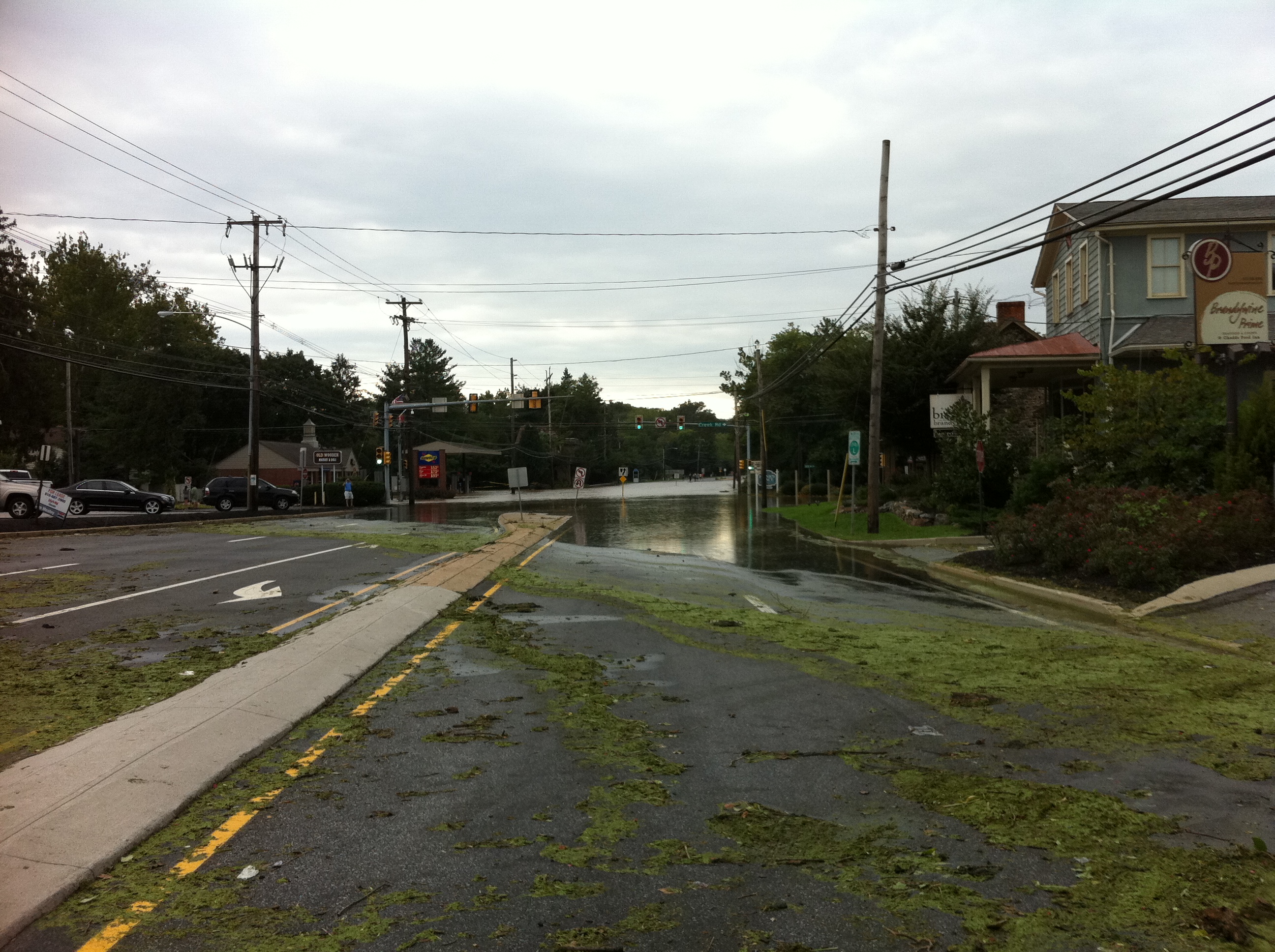
Took a walk down to Creek Rd and Rte 1 to see how bad the flooding was. For those who didn’t go by, here’s a view of the high-water line of swamp scum. I’m standing even with Brandywine Prime. George Thorpe and Joe Barakat were there monitoring the state of affairs.

Regular blog comments to follow shortly. Note the new blog by Kathleen Do and Gregg Lindner, candidates for UCF School Directors, added to out blogroll.

Coddling the Innocent

Last week, the NJ Supreme court under chief justice Stuart J. Rabner issued a unanimous 134 page decision mandating revision of the way eyewitness testimony is handled in that state (see NY Times article). Basically, the court acknowledged the legitimacy of 2 or 3 decades of research by psychologists that shows memory is not only fallible but malleable. Malleability is particularly a problem in police line-ups, in which officers who know which candidate is the suspect can inadvertently provide cues to the witness. Among the data considered were facts gathered by the Innocence Project (see executive summary) such as that of 230 people exonerated by DNA testing, 75% had been convicted based on eyewitness identification. The court of course did not throw out eyewitness testimony, it simply allowed greater latitude in the courtroom for challenging the accuracy of eyewitness ID.

Even without the benefit of scientific papers, our flawed memory is obvious to all of us who ever failed to recognize someone in the grocery store who we had met at a party the weekend before. We humans are amazingly adept at recognizing people we know well. You walk into a restaurant, glance into the back and instantly say, “Hey, look, Jenny and Ryan are here!” However, we’re not very good at recognizing a stranger we briefly encountered a few days (or even hours) ago. Especially when the encounter was stressful, and even more so when the stranger was of another race (I guess “they” all do look alike to “us”).

So why is this blogworthy? First, it’s rare to see a court ruling that matches both common sense and science. What gets my goat, though, is the conservatives’ knee-jerk response, epitomized by a reader comment on the Times article: “Jest [sic] another step in the ongoing process of uplifting the criminal and trodding [sic] on the victim.”

Yes, conservatives look at this as just another way that soft-hearted liberal wackos coddle criminals. For the life of me, I can’t understand why it is that conservatives view any attempt at keeping innocent people out of jail as being “soft on crime.” Wouldn’t you think that the really hard-line law and order types would be the most interested in keeping the innocent out of jail, rather than the least? Why? Because for every innocent person convicted of a crime there’s an actual criminal running around free and laughing with glee that some poor schmuck is going to do his time. What, exactly, is so law and order about letting people get away with crime? Yet that’s what conservatives do when they attack every rule that makes it harder for the wrong people to be convicted. I think every time we hear the conservatives squawk about police and prosecutors having to behave fairly and scientifically, we accuse them of being soft on crime.

Does God Hate Rick Perry?

You have to wonder. In April, Mr. Perry responded to the drought that had stricken Texas for several months by calling on Texans to join him in praying for rain. Now I don’t expect much from politicians in general, and I certainly don’t expect them to be able to make it rain, so I guess I can’t get too worked up if one decides to try a “hail Mary” play on the off chance that it might help.

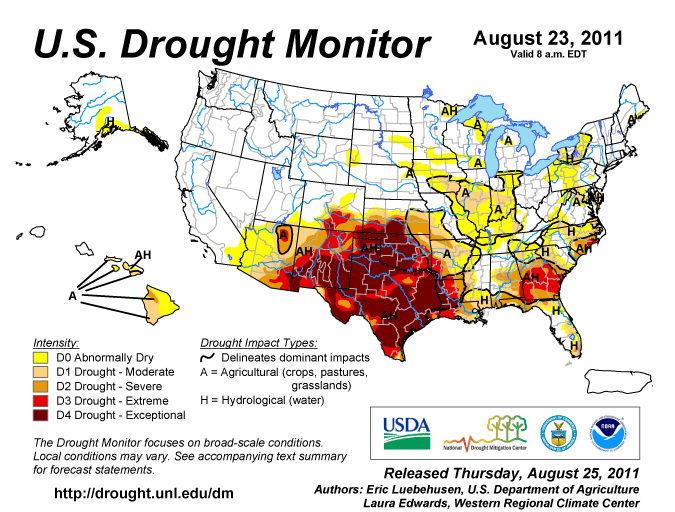
So how did that work out, exactly? Well, take a look at the drought map put out Thursday Aug. 25 by the good folks at the National Drought Mitigation Center http://droughtmonitor.unl.edu/monitor.html affiliated with the University of Nebraska:


Looks like Texas is on somebody’s shit list. It’s the droughtiest spot in the country, the bull’s eye of dry. It is clearly being singled out for special treatment, but not the treatment that was prayed for. Pretty much the exact opposite, as a matter of fact. Instead of more rain, Texas got more drought. Hmmm. Well we know God couldn’t have confused “more rain” with “less rain,” and even Rick Perry supporters know the difference between wet and dry. What could’ve happened? Since we have no doubt that God listens to Rick Perry’s prayers, looks pretty likely She’s peeved with Rick and is taking it out on Texas. Not only Texas, but the rest of us as well. The East is getting flooded out with extra rain that must’ve been due Texas. If that’s what happens when Perry prays for Texas, do we want him praying for the whole country when he’s in charge? I pray that doesn’t happen.

Obamacare

So, I read that the hero of the South, Rick Perry, has as one of his main platforms repeal of the Affordable Care Act, which he charitably refers to as “Obamacare.” He and all the other Republicans who bandy this term about seem to think it’s a smart move on their part to link President Obama very tightly to health care reform. That way, all the people who would’ve gotten thrown off their health insurance plan for getting too sick, or who got too sick to work and then couldn’t buy coverage at any price would know who to blame for them still being able to get medical care. Good idea, Republicans. For once I agree with you. Mr. Obama deserves full credit for being the first president in American history to get a majority (barely) of Congress to agree that civilized countries ensure their citizens are cared for when they are hurt or sick, rather than the “survival of the richest” medical plan that is the essence of Republican health care policy. Yes, this is Obama’s care plan and I thank him for it. You will too if you lose your job and then get sick.

 Oh, we can’t afford it? I say we can’t afford foreign wars that attempt to reform the unreformable and a war machine that can fight any country anywhere anytime that we say threatens our “interests”. We can’t afford to have multi-billion dollar corporations pay little or no taxes just so their leaders and owners will donate to right-wing candidates (to be fair, they’d donate to left wing candidates that would also maintain their breaks). Let’s take care of Americans for a while.

Rick Perry, Savior of the South

Latest in the parade of good-looking white people who want to be the Republican candidate for president of the United States is someone who isn’t always sure he even wants to be part of the United States. Of course, it’s already mandatory that Republican candidates to run the government must not believe there should even be government. Except for the military. That’s like a candidate for school superintendent running on a platform of closing the school but keeping the football team. Oh wait, that’s probably a common position in Texas. Anyway, given that incongruity, it’s a minor step for Republicans to run a candidate to lead the country whose response to not getting what he wants is to break up the country. The candidate, of course, is Rick Perry—he of the secession talk in 2009, in which he declared Texas’ right to leave the USA should it so choose. Of course, maybe as a true-blooded Southerner he was just feeling mournful about how poorly it worked out for them the last time they tried that. Well, I feel for him, and I’m willing to review the results of the War Between the States on not-so-instant replay and…declare victory for the South. You won. You’re free to go, along with your anti-evolution, why do we need a central bank, keep the brown people out, slavery wasn’t really so bad candidates. And don’t let the door hit you in the ass on your way out.

Your money or your life

I saw some car decals the other day that neatly summed up the conservative paradox. Right next to each other on the back window of a big, black SUV were the decals “T.E.A.” (taxed enough already—the TEA party) and “Semper Fi” (the slogan of the Marines). “Semper Fi,” of course is to send the message that the driver is willing to give up his life or his children’s lives to do whatAmericaneeds to have done. The “TEA” means that the driver is not willing to spend his money to do what America needs to have done.

Now I have two sons and fortunately have not had the experience of losing one of them. However, I have paid a lot of money in taxes. Although I don’t like paying taxes, I somehow don’t think the pain of spending a little more money could be anywhere near the agony of losing a child. Yet the 2 decals I saw suggest I’ve somehow got it backwards. The driver appears to value his money more than his children’s lives.

Why does the government’s call to spend your life remain unquestioned and unquestionable to the same people who march in the streets and spit venom at any governmental request for the lesser sacrifice of money? The disconnect  seems to transcend mere policy differences—the specific war we are asked to fight, the specific program we are asked to fund. A segment of our population embraces the concept of sacrificing a child and rejects the concept of sacrificing a portion of their income. But isn’t it the same thing, only of different magnitude? And the magnitude of the sacrifice is much, much greater when a life is given up. I think even the driver with the decals would admit this if asked explicitly, so I’d like to hear him explain why he glorifies the one sacrifice and vilifies the other? Are we not equally being asked to give of ourselves that others might benefit?

What’s even more interesting is the difference in the opportunity to contribute. Even if we wanted too, we couldn’t all serve in the Marines and fire a weapon on the front line, but we could all proudly pay for our government and its programs—and honor those who do.

The game begins

The Chadds Ford Democrats are entering the 21st C. with a blog. We aim to have a community forum to discuss news, ideas, plans (and, yes, probably a few rants) about issues of the day. Many of us miss the give and take of the letters section of the old Chadds Ford Post. Well, we’d like to duplicate that here but with minutes instead of weeks between comment and rebuttal. Let’s see how it goes.

I think an appropriately historic way to start off is with a quote from an important Republican icon:

“The money powers prey upon the nation in times of peace and conspire against it in times of adversity. It is more despotic than a monarchy, more insolent than autocracy, and more selfish than bureaucracy. It denounces as public enemies, all who question its methods or throw light upon its crimes…. corporations have been enthroned and an era of corruption in high places will follow, and the money powers of the country will endeavor to prolong it’s reign by working upon the prejudices of the people until all wealth is aggregated in a few hands and the Republic is destroyed.” —Abraham Lincoln